



By Amy & Srinu Regeti — The Regeti’s | South Asian Wedded Life (SAWL)
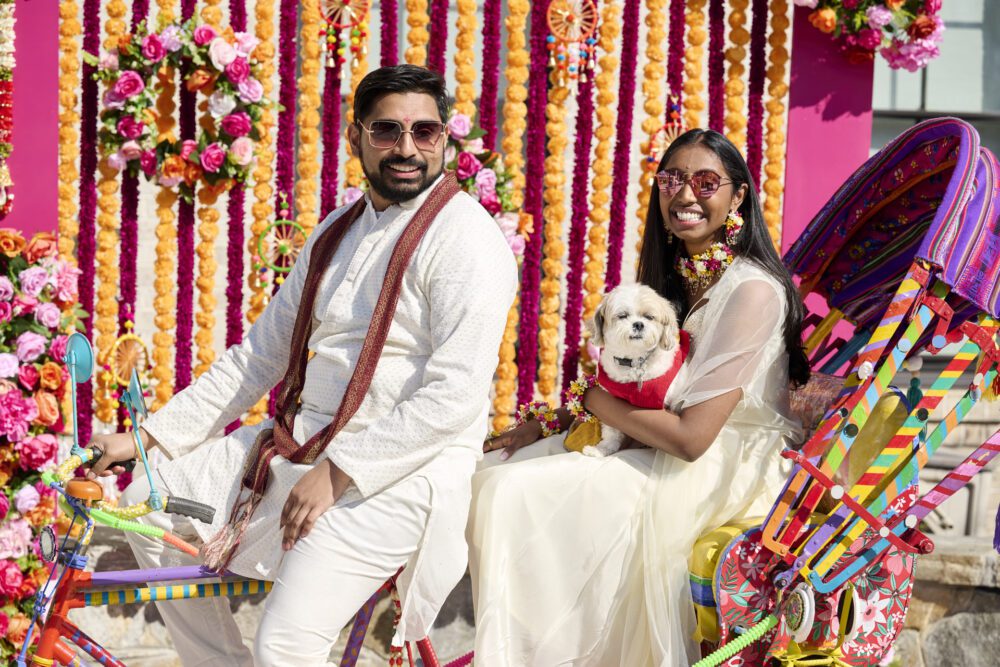
A Quiet Moment Between Color and Celebration
There’s a beautiful stillness that happens between the Haldi and the Mehndi.
The laughter and playfulness of turmeric give way to a softer rhythm — a moment when elders gather, prayers are whispered, and the bride and groom receive blessings that have been passed down through generations.
It’s a space where the noise settles. The hands that just moments ago smeared turmeric now fold gently in reverence.

The Aashirwad — A Shower of Blessings
The Aashirwad Ceremony is the heart of this in-between moment. Here, elders bless the couple for prosperity, health, and harmony in their married life. A small tilak is placed on the forehead — a sacred mark of protection — and the couple bows to touch the feet of parents and grandparents in gratitude.
It’s tender, humbling, and profoundly grounding.

For families living between cultures, this ritual often becomes a bridge — a way to pause and include grandparents, aunts, and uncles in the spiritual fabric of the wedding. Whether in a backyard, a temple, or a living room, it’s the reminder that every modern love story stands on ancient roots.

Charan Sparsh and the Painting of the Feet
In many regions of India, the blessings continue with a ritual called Charan Sparsh or Paad Puja — the touching or washing of the feet.
Family members lovingly wash or anoint the groom’s feet with turmeric, milk, honey, and rose water — a symbolic gesture of purification and respect. In some traditions, especially South Indian or fusion celebrations, his feet are then painted with a soft red dye (known as alta) or turmeric paste, marking protection and good fortune as he steps into marriage.
It’s poetic, really — the act of preparing one’s very steps for a new journey.

A Personal Note from Amy
I’ll never forget the first time I witnessed these blessings up close — not as a photographer, but as a family member.
When Srinu’s younger brother got married in India, I found myself right in the middle of it all — sari shopping, family meetings, and rituals I barely understood — and yet, it was one of the most eye-opening experiences of my life.
As the elder brother and sister-in-law, our roles carried a kind of weight I hadn’t fully realized. There were expectations, traditions, and invisible hierarchies that suddenly became very visible. I remember the tension of wanting to do things right, to honor everyone, and yet feeling completely lost at times.
There was one particular moment that stayed with me.
The bride’s family arrived — confident, influential, and eager to make their presence felt. What should have been a gesture of giving — selecting saris and gifts — turned into a negotiation, their preferences taking precedence over ours. It was my first real taste of how deeply layered Indian weddings can be — love, pride, respect, and ego all dancing in the same space.
But the most painful part came quietly. When it was time to paint my brother-in-law’s feet with alta — a ritual I had been preparing myself for, emotionally and culturally — one of the bride’s relatives simply stepped in and did it for me. There was no malice, just an assumption that I wouldn’t want to, or didn’t know how.
And in that moment, I felt invisible. Not out of rejection, but out of my own ignorance — not knowing enough to belong.
That moment shaped me. It humbled me, broke me a little, and built something new in me all at once.
Because now, when I stand behind a camera watching a bride navigate the complexities of family, faith, and culture — I see her. I know what it feels like to be caught between belonging and observing. And I’ll never let one of our clients feel unseen in that same way.
That’s the heart of what The Regeti’s stand for — capturing not just the rituals, but the reverence behind them, and making sure everyone — every culture, every role — feels recognized.

Why It Matters
In a world where wedding timelines are often packed and rituals get condensed, this quiet pause between the Haldi and Mehndi is worth keeping.
It’s the moment when families come together not as hosts or planners, but as blessings themselves.
It’s where the spiritual meets the emotional — where generations align their hopes and hearts before the celebrations begin again.

As photographers, these are the frames we love the most — the gentle smiles, the bowed heads, the hands that linger a second longer than needed. They’re the unseen threads that bind the whole wedding together.

Through Our Lens
We’ve witnessed these ceremonies take place under mango trees, in suburban living rooms, and beside prayer mandaps draped in marigolds. Every time, it feels sacred — not in its formality, but in its sincerity.
Between the turmeric and the henna lies the heartbeat of every Indian wedding:
The blessings that bind.

Where Your Journey Continues
However you arrived here — whether you’re planning a wedding, documenting one, or simply drawn to the stories that connect us — we’d love for you to stay a while and explore more of what we’re building.
🔗 www.sawl.life — We’re just getting started, and we’d love for you to join the community.
📖 www.amazon.com/author/amyregeti — Browse our books, guides, and clarity tools for South Asian brides and families.
🎧 Podcast / YouTube: South Asian Wedded Life — Find us on Spotify, Apple, or YouTube.
If you’re planning your wedding and wondering how to weave both tradition and togetherness into your events, reach out to us for a conversation at The Regeti’s — we’d love to help you tell your story in a way that feels beautifully, meaningfully you.